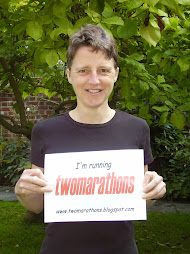
It would be more accurate to say "injury update", but the effort I'm putting into overcoming this injury certainly feels like training! The week of rest and anti-inflammatories having done very little other than to leave me feeling unfit, I went to see a physiotherapist, who came up with a totally different diagnosis! Apparently the problem is "iliotibial band friction syndrome". Despite sounding very grand, this is actually an extremely common runners' problem. The pain is due to a long tendon (stretching from the hip to below the knee) rubbing on the end of the thigh bone in the knee area. In my case, this seems to be due to a muscle imbalance in my hip, maybe due to some leg injury I can't even remember. Compensating for the imbalance, I use the wrong muscles to bring my leg forward when I run, and so the tendon scrapes on the bone rather than making a smooth passage past it!
So much for the anatomical explanation; what about the cure? Exercises! And more exercises, followed by some exercises for good measure. Four times a day you will find me in front of the mirror concentrating intently on keeping my pelvis straight as I lunge, bend, and generally contort myself in the interests of waking up those lazy muscles! And they're certainly letting me know about it. I should have impressive quads after this, if nothing else! If I have any time to spare between the muscle-strengthening exercises, I can also cycle (or use the exercise bike as is more likely in this weather), so my cardio-vascular system doesn't need to go into hibernation.
It has to be said that this is entirely not the form I expected my training to be taking at this stage. However, despite the lack of actual running, I know I'm building up all the important aspects of my fitness, and so I'm staying optimistic. After all, if I don't believe I can achieve my aims, who will?
Monday, 2 February 2009

Monday, 26 January 2009
WPF Therapy - A safe place to talk
Nobody's life runs hiccup-free; times of stress, unhappiness and discouragement are a normal part of existence. But when these feelings persist, and have a negative impact on one's ability to function, it can be very difficult to move beyond them independently. The role of WPF Therapy is to help people experiencing all sorts of emotional, personal or relationship problems, such as anxiety, bereavement, eating disorders, lack of confidence, depression, and loneliness. By talking, exploring and reflecting, clients are helped to develop their awareness of the choices they have in their life and to see their way forward. Problems and distress in the present never stand in splendid isolation; there is always some cause or set of causes. Understanding what underlies one's difficulties can be the first step in personal growth. This is where a trained and non-judgemental counsellor or psychotherapist can help by acting as a catalyst in the process, through active listening and facilitative questioning and commenting.
Because one size doesn't fit all, a variety of treatment approaches are offered at WPF Therapy. These include short-term and open-ended counselling, cognitive behavioural therapy (which addresses thinking patterns and styles), group therapy, and more in-depth psychotherapy. A recommendation is made after the initial consultation as to which of these is most appropriate. In all cases, the sliding scale of payment ensures that everybody has access to a safe place to talk. Statistics show that every year in the UK, 91 million working days are lost to mental illness, and 4,000 people take their own lives. WPF Therapy works to reduce this shocking amount of human suffering by acceptance of each individual, empowering them to move forward from their place of struggle. What a great thing to do!
Because one size doesn't fit all, a variety of treatment approaches are offered at WPF Therapy. These include short-term and open-ended counselling, cognitive behavioural therapy (which addresses thinking patterns and styles), group therapy, and more in-depth psychotherapy. A recommendation is made after the initial consultation as to which of these is most appropriate. In all cases, the sliding scale of payment ensures that everybody has access to a safe place to talk. Statistics show that every year in the UK, 91 million working days are lost to mental illness, and 4,000 people take their own lives. WPF Therapy works to reduce this shocking amount of human suffering by acceptance of each individual, empowering them to move forward from their place of struggle. What a great thing to do!
Monday, 19 January 2009
What does RTU do? - 4. Rural Development Programme
What can a woman do when her husband has died, she has young children to look after, no savings and no income? What alternative does she have to a life of poverty and dependence on charity?
In 26 rural villages in Southern India, she can join a self-help group of women in similar circumstances. Run by local people with the support of RTU, the groups empower the most desperate and needy in these communities to transform their lives. Through micro-finance schemes, women have access to small loans with nominal interest rates. This enables them to set up businesses without becoming entrapped in the cycle of debt associated with borrowing from local money-lenders, who can charge interest rates of 60% or more. The "businesses" I am talking about really are very small - perhaps growing vegetables or making clothes, to sell within the village - yet they can make the difference between misery and dignity.
The women in the self-help groups also meet regularly to offer mutual support. They can talk and share their concerns and successes. There are opportunities to learn about health issues and about women's rights. A very deep need is filled in this way; often for the first time, these women realise that each one is a respected and valued person who has a role in their community and in the world, and whose actions can influence the quality of their life. It is, more than anything, this empowerment which I find inspiring. Everywhere in the world, no-one should be denied the chance to construct a worthwhile and meaningful life for themselves and their families.
In 26 rural villages in Southern India, she can join a self-help group of women in similar circumstances. Run by local people with the support of RTU, the groups empower the most desperate and needy in these communities to transform their lives. Through micro-finance schemes, women have access to small loans with nominal interest rates. This enables them to set up businesses without becoming entrapped in the cycle of debt associated with borrowing from local money-lenders, who can charge interest rates of 60% or more. The "businesses" I am talking about really are very small - perhaps growing vegetables or making clothes, to sell within the village - yet they can make the difference between misery and dignity.
The women in the self-help groups also meet regularly to offer mutual support. They can talk and share their concerns and successes. There are opportunities to learn about health issues and about women's rights. A very deep need is filled in this way; often for the first time, these women realise that each one is a respected and valued person who has a role in their community and in the world, and whose actions can influence the quality of their life. It is, more than anything, this empowerment which I find inspiring. Everywhere in the world, no-one should be denied the chance to construct a worthwhile and meaningful life for themselves and their families.
Monday, 12 January 2009
The first hurdle - no jumping allowed!
No jumping, no cycling, no swimming, and more to the point, no running allowed, for at least a week! Well, it just couldn't continue so smoothly really; where would the challenge have been? (Actually I think there might have been enough challenge, but that clearly reflects my lack of grit...)
When I came back from a run on Christmas Eve with some pain behind my knee, I decided to give it a rest for a couple of weeks as is my usual response to niggles. Unfortunately this niggle decided not to go away, so I took it to the doctor today to see if she could give it a good talking to. Happily, since all my ligaments seem to be in good nick and there is no tenderness or external sign of a problem, the probable cause is a simple muscle strain being aggravated by daily activity. That explains the total ban on exercise for the next little while! I've also got some anti-inflammatories to speed the healing process. The timing is not brilliant, with only three months and one week until the first marathon, but it could be worse (three days and one hour before, for example). So I'm being patient and optimistic, knowing that a few weeks' rest now will mean much more rapid progress later. Since my objective is to get round, at least I don't have to worry that I won't reach my target time! Anyone got a spare torch?
Needless to say, I will be shifting my focus to fundraising, fundraising and fundraising for the next little while. Today I have passed the halfway mark for both charities, which is really something to smile about. Hooray!
When I came back from a run on Christmas Eve with some pain behind my knee, I decided to give it a rest for a couple of weeks as is my usual response to niggles. Unfortunately this niggle decided not to go away, so I took it to the doctor today to see if she could give it a good talking to. Happily, since all my ligaments seem to be in good nick and there is no tenderness or external sign of a problem, the probable cause is a simple muscle strain being aggravated by daily activity. That explains the total ban on exercise for the next little while! I've also got some anti-inflammatories to speed the healing process. The timing is not brilliant, with only three months and one week until the first marathon, but it could be worse (three days and one hour before, for example). So I'm being patient and optimistic, knowing that a few weeks' rest now will mean much more rapid progress later. Since my objective is to get round, at least I don't have to worry that I won't reach my target time! Anyone got a spare torch?
Needless to say, I will be shifting my focus to fundraising, fundraising and fundraising for the next little while. Today I have passed the halfway mark for both charities, which is really something to smile about. Hooray!
Saturday, 3 January 2009
Happy New Year!
It's the third day of 2009 and a beautiful sunny one. Seeing a clear blue sky always generates in me a sense of optimism and confidence. Since I will need plenty of both over the next three and a half months, I'm praying for good weather! The countdown is really beginning now, with lots of training and fundraising still to do. I guess the New Year always makes us think about our prospects for the next 12 months, maybe more than ever this year with so many predictions of deep recession at home and abroad. It's not an easy time to be asking people for money. However, the financial insecurity I'm witnessing in so many people around me inspires me more than ever about the charities I've chosen. For the poor of Tamil Nadu served by Reaching the Unreached, need is not a fear but a daily, grinding reality which for most of us can cast a clear light onto our prosperity-based worries. Yet with jobs at risk and the combination of rising prices and falling income making established lifestyles untenable, many people in this country are at risk of crippling anxiety and depression. WPF Therapy's services, and particularly their reduced fees for those on low income, are likely to be more needed than ever.
Perhaps now is a good time to have a look at our own standard of living and whatever challenges we are facing in our lives, and to appreciate how lucky so many of us are. Of course, appreciation in a vacuum won't help the situation - so some redistribution of wealth could be considered! In that context I'd like to express my gratitude once more for the generosity you have all shown. It's wonderful to see the running totals rising - almost half way now! And so many promises and pledges. I'm looking forward, with blue-sky confidence, to seeing those promises being transformed into donations in the coming weeks. And you can look forward to me transforming good intentions into action, as I re-double my efforts to make this project a success.
Perhaps now is a good time to have a look at our own standard of living and whatever challenges we are facing in our lives, and to appreciate how lucky so many of us are. Of course, appreciation in a vacuum won't help the situation - so some redistribution of wealth could be considered! In that context I'd like to express my gratitude once more for the generosity you have all shown. It's wonderful to see the running totals rising - almost half way now! And so many promises and pledges. I'm looking forward, with blue-sky confidence, to seeing those promises being transformed into donations in the coming weeks. And you can look forward to me transforming good intentions into action, as I re-double my efforts to make this project a success.
Saturday, 20 December 2008
What does RTU do? - 3. Housing
You may have noticed that it's nearly Christmas. I wonder where you will be celebrating? Perhaps in your own home; perhaps with your parents or your grown-up children; perhaps somewhere quite different. Wherever you'll be this year though, the chances are that the house will be warm, dry, and safe. So it seemed like a good moment to pause and think about the housing in the area of Southern India covered by Reaching the Unreached. For a long time, the poverty of the villagers has meant that they have lived in inadequate huts. Roughly constructed with mud walls and thatched rooves, these one-room "houses" let in the rain and poisonous snakes, have no sanitary facilities, and are often completely destroyed in strong winds. They need re-construction on an annual basis, at a cost which many families cannot afford. This forces them to go to money-lenders, who charge high interest rates (60% or more), and so the cycle of poverty and debt is reinforced.
Since 1976, RTU have been constructing simple but sturdy houses for the most needy local people. These houses are made of brick, with tiled rooves. They have a living area, sometimes partitioned for privacy, a kitchen, a bathroom, and a veranda. Each house costs approximately £450 to construct. Over 7,500 have been built so far. Villagers apply for an RTU house, and their need is carefully assessed. If they are successful, they are fully involved in the planning and the construction of the house. I particularly appreciate this empowerment of the local people, rather than forcing them into the role of passive receivers of charity. Moreover, the bricks, tiles, window frames and so on are all made in an RTU factory, providing employment for local people, and using local materials which are not harmful to the environment.
Each year, Lasallian Developing World Projects, founded by the De La Salle order, sends teams of young people to developing countries to participate in building projects. Since 2005 this has included the Rural Housing Programme of RTU. One returned volunteer wrote, "There was nothing that we did that could not have been done by the people of the village. We could have just sent a cheque. So what was the point?". This volunteer goes on to describe how each member of the team gained enormous insights into the local culture and the impact of poverty there, and how humbled they were by the generosity of the local people. It seems, also, that the locals were delighted to receive these Westerners; it was evidence that people cared about their situation and were making real efforts to help. The mutual benefits of such projects are obviously manifold. The young people particularly appreciated being invited to the house-warming parties. These involve lighting candles, cracking open a coconut, and sharing warm milk, cake and fruit. Perhaps during the next week we can remember the delight of these people in moving into their new homes, and appreciate our own homes a little more.
Since 1976, RTU have been constructing simple but sturdy houses for the most needy local people. These houses are made of brick, with tiled rooves. They have a living area, sometimes partitioned for privacy, a kitchen, a bathroom, and a veranda. Each house costs approximately £450 to construct. Over 7,500 have been built so far. Villagers apply for an RTU house, and their need is carefully assessed. If they are successful, they are fully involved in the planning and the construction of the house. I particularly appreciate this empowerment of the local people, rather than forcing them into the role of passive receivers of charity. Moreover, the bricks, tiles, window frames and so on are all made in an RTU factory, providing employment for local people, and using local materials which are not harmful to the environment.
Each year, Lasallian Developing World Projects, founded by the De La Salle order, sends teams of young people to developing countries to participate in building projects. Since 2005 this has included the Rural Housing Programme of RTU. One returned volunteer wrote, "There was nothing that we did that could not have been done by the people of the village. We could have just sent a cheque. So what was the point?". This volunteer goes on to describe how each member of the team gained enormous insights into the local culture and the impact of poverty there, and how humbled they were by the generosity of the local people. It seems, also, that the locals were delighted to receive these Westerners; it was evidence that people cared about their situation and were making real efforts to help. The mutual benefits of such projects are obviously manifold. The young people particularly appreciated being invited to the house-warming parties. These involve lighting candles, cracking open a coconut, and sharing warm milk, cake and fruit. Perhaps during the next week we can remember the delight of these people in moving into their new homes, and appreciate our own homes a little more.
Wednesday, 10 December 2008
Why run for WPF Therapy?
In the UK, approximately 1 in 4 people experience a mental health problem at some point in their lives, and over 4000 people take their own life each year. To me those figures say: 1.) this is common; 2.) this is serious.
At WPF Therapy, over 500 hours of assessment and treatment take place every week. That's a lot of people given a safe place to talk. Because charges are means-tested, people from all backgrounds and standards of living can access the service, giving them the chance to face the difficulties they are experiencing and to move forward.
Although these would be more than adequate reasons to run a marathon for WPF Therapy, I have a personal motivation as well: my own experience of depression.
It's hard to compress a personal story into a paragraph or two, but perhaps you can fill in some of the gaps. I first experienced depression as a teenager, and this recurred several times in subsequent years. For most of this time I was undiagnosed, unsupported, wrongly diagnosed or badly supported. I was ashamed of what I was going through and imagined that nobody would understand what I was feeling. Moreover, I didn't believe that anything could be done to help. When something eventually spurred me to speak more honestly to my GP, he sent me for six sessions of brief counselling and put me on anti-depressants. The drugs helped - they gave me enough energy and positivity to move forward with my life. The counselling didn't - six sessions barely scratched the surface and I wasn't offered more. So why would I be enthusiastic about WPF Therapy, which offers counselling? Simply because they only stop after six sessions if six sessions is enough! Simply because they offer a client-centred approach, empowering each individual to take responsibility for their lives and to make the changes needed. Simply because they are there, de-stigmatising mental health difficulties and respecting their clients. Simply because they are intervening at the level of causes, not of symptoms. Simply because they make a difference.
I'm glad of the experience I've lived through; I wouldn't be the "me" I am without it. But I'm glad of it mostly because I can turn it to good. By speaking out I can help to cut through the taboos and stigma so that other people won't have to negotiate such a mire of isolation and hopelessness. With increased awareness of and openness about mental health problems, resulting in their earlier identification, and with improved availability and affordability of talking therapies, personal suffering could be reduced dramatically. So "thankyou" WPF Therapy for your part in that! And "thankYOU", that's YOU - my supporters - for funding their work.
At WPF Therapy, over 500 hours of assessment and treatment take place every week. That's a lot of people given a safe place to talk. Because charges are means-tested, people from all backgrounds and standards of living can access the service, giving them the chance to face the difficulties they are experiencing and to move forward.
Although these would be more than adequate reasons to run a marathon for WPF Therapy, I have a personal motivation as well: my own experience of depression.
It's hard to compress a personal story into a paragraph or two, but perhaps you can fill in some of the gaps. I first experienced depression as a teenager, and this recurred several times in subsequent years. For most of this time I was undiagnosed, unsupported, wrongly diagnosed or badly supported. I was ashamed of what I was going through and imagined that nobody would understand what I was feeling. Moreover, I didn't believe that anything could be done to help. When something eventually spurred me to speak more honestly to my GP, he sent me for six sessions of brief counselling and put me on anti-depressants. The drugs helped - they gave me enough energy and positivity to move forward with my life. The counselling didn't - six sessions barely scratched the surface and I wasn't offered more. So why would I be enthusiastic about WPF Therapy, which offers counselling? Simply because they only stop after six sessions if six sessions is enough! Simply because they offer a client-centred approach, empowering each individual to take responsibility for their lives and to make the changes needed. Simply because they are there, de-stigmatising mental health difficulties and respecting their clients. Simply because they are intervening at the level of causes, not of symptoms. Simply because they make a difference.
I'm glad of the experience I've lived through; I wouldn't be the "me" I am without it. But I'm glad of it mostly because I can turn it to good. By speaking out I can help to cut through the taboos and stigma so that other people won't have to negotiate such a mire of isolation and hopelessness. With increased awareness of and openness about mental health problems, resulting in their earlier identification, and with improved availability and affordability of talking therapies, personal suffering could be reduced dramatically. So "thankyou" WPF Therapy for your part in that! And "thankYOU", that's YOU - my supporters - for funding their work.
Tuesday, 2 December 2008
Training update 2
It's now just 4½ months until the Bungay Black Dog! With this in mind I have been licking my training schedule into shape over the last little while. That means it's now more interesting, and hopefully more effective, than the "60 minutes steady run round the park" I was doing 2 or 3 times a week. According to the experts there are several important kinds of training, incorporating different speeds and distances; these in combination are meant to build up fitness and endurance, for example by making the muscles more effective in their use of the oxygen in your blood. I find the body's capacity to adapt to exercise (in other words to get fitter) really amazing. I never expect it to work!
At the moment I'm still only managing three runs a week, but they are quite varied. Perhaps the most important one (definitely for my psychological readiness if nothing else) is the "long run", which I'm increasing by 10 minutes (about a mile) a week. I should be at a half-marathon distance next week or the week after, which works out right for this length of time before the marathons. Then I have an "interval run", a very new and challenging discipline for me, which involves (after a warm-up period of gentle running) alternating fast running with jogging to recover. My most recent interval run included eight repetitions of 90 seconds fast and 90 seconds jog. Let's say it was good to stop! The final run is a bit of a hybrid at the moment, as I've tried to compress into it a steady run and a tempo run. Tempo, or threshold, running is even harder for me than intervals - it means running at the limit of your aerobic capacity so that you can keep going, but only just! Finding this whole idea rather scary, I've started by trying to put a bit of this type of running into the middle of an hour's steady run. I'm not sure I'm running fast enough for the "threshold" section of it, but to run any faster than my standard speed for longer than a minute or two is already an achievement!
The great thing is that I can see the evidence that these efforts are working. If I drop back down to something that seemed hard a few weeks ago, it's now noticeably easier. The tiredness of my legs after a run doesn't last as long. I can make a bit more of an effort up a hill or against the wind without gasping for breath. Maybe I will be able to run a marathon! Maybe even two!
Looking back over my posts I see I haven't said a lot so far about WPF Therapy. It's next on the list, so keep an eye out!
At the moment I'm still only managing three runs a week, but they are quite varied. Perhaps the most important one (definitely for my psychological readiness if nothing else) is the "long run", which I'm increasing by 10 minutes (about a mile) a week. I should be at a half-marathon distance next week or the week after, which works out right for this length of time before the marathons. Then I have an "interval run", a very new and challenging discipline for me, which involves (after a warm-up period of gentle running) alternating fast running with jogging to recover. My most recent interval run included eight repetitions of 90 seconds fast and 90 seconds jog. Let's say it was good to stop! The final run is a bit of a hybrid at the moment, as I've tried to compress into it a steady run and a tempo run. Tempo, or threshold, running is even harder for me than intervals - it means running at the limit of your aerobic capacity so that you can keep going, but only just! Finding this whole idea rather scary, I've started by trying to put a bit of this type of running into the middle of an hour's steady run. I'm not sure I'm running fast enough for the "threshold" section of it, but to run any faster than my standard speed for longer than a minute or two is already an achievement!
The great thing is that I can see the evidence that these efforts are working. If I drop back down to something that seemed hard a few weeks ago, it's now noticeably easier. The tiredness of my legs after a run doesn't last as long. I can make a bit more of an effort up a hill or against the wind without gasping for breath. Maybe I will be able to run a marathon! Maybe even two!
Looking back over my posts I see I haven't said a lot so far about WPF Therapy. It's next on the list, so keep an eye out!
Subscribe to:
Posts (Atom)